 NexGPU-算力租赁,GPU服务器,GPU云算力,AI服务器租用-新闻博客
Agents Are Not Single Calls: GPUs Need to Stay On
Recently, teams building AI applications have felt a clear shift. Previously, calling a large model meant sending a prompt and receiving a reply, and that was it. Now, once agents go live, planning, tool invocation, result checking, and looping are all part of the process—a single task can easily run for ten to twenty rounds. Industry analysis shows that these agentic workflows consume 5 to 30 times more tokens per task than a typical conversation, and in some complex coding or enterprise scenarios, even more. The result is that GPUs are no longer "turn on, use, then shut down" resources; they become near-constant baseline loads.
In the domestic industry, it's been mentioned that the scale of agent internet connections could reach hundreds of billions, and inference compute is quickly surpassing training, achieving over 10x growth. Centralized cloud compute is evolving toward edge-device collaboration, but for now, most small and medium teams rely on cloud GPUs. The problem is: demand has shifted from intermittent peaks to continuous fluctuations—how do you rent and schedule to avoid burning through your budget?
Rental Market Tightens, Price Sensitivity Rises
Looking at recent rental data, prices for mainstream cards like H100 on short-term and one-year contracts have rebounded significantly from last year's lows. Some tracking shows overall rental prices have risen 5-10% since July, with even bigger increases for newer cards. On the supply side, there are improvements, but agents and continuous inference have pushed utilization higher, with many nodes nearly at full capacity. Some practitioners do the math: at roughly $3 per GPU-hour, a 1024-card cluster running agent workflows 24/7 costs over $2.6 million a month in hardware alone, not counting failed retries and idle waste.
This isn't meant to scare you. Many teams find that token prices are falling during the pilot phase, but once in production, the cost to complete a task multiplies several times over. Re-sending context, reloading tool schemas, and failed loops—these "invisible multipliers" inflate the bill. The market has shifted from "scrambling for cards" to "competing on delivery and elasticity." For small and medium teams, fixed buyouts or long-term contracts carry more lock-in risk, making elastic rental a safer bet.
First Step: Break Down Loads by Task, Don't Stack GPUs Right Away
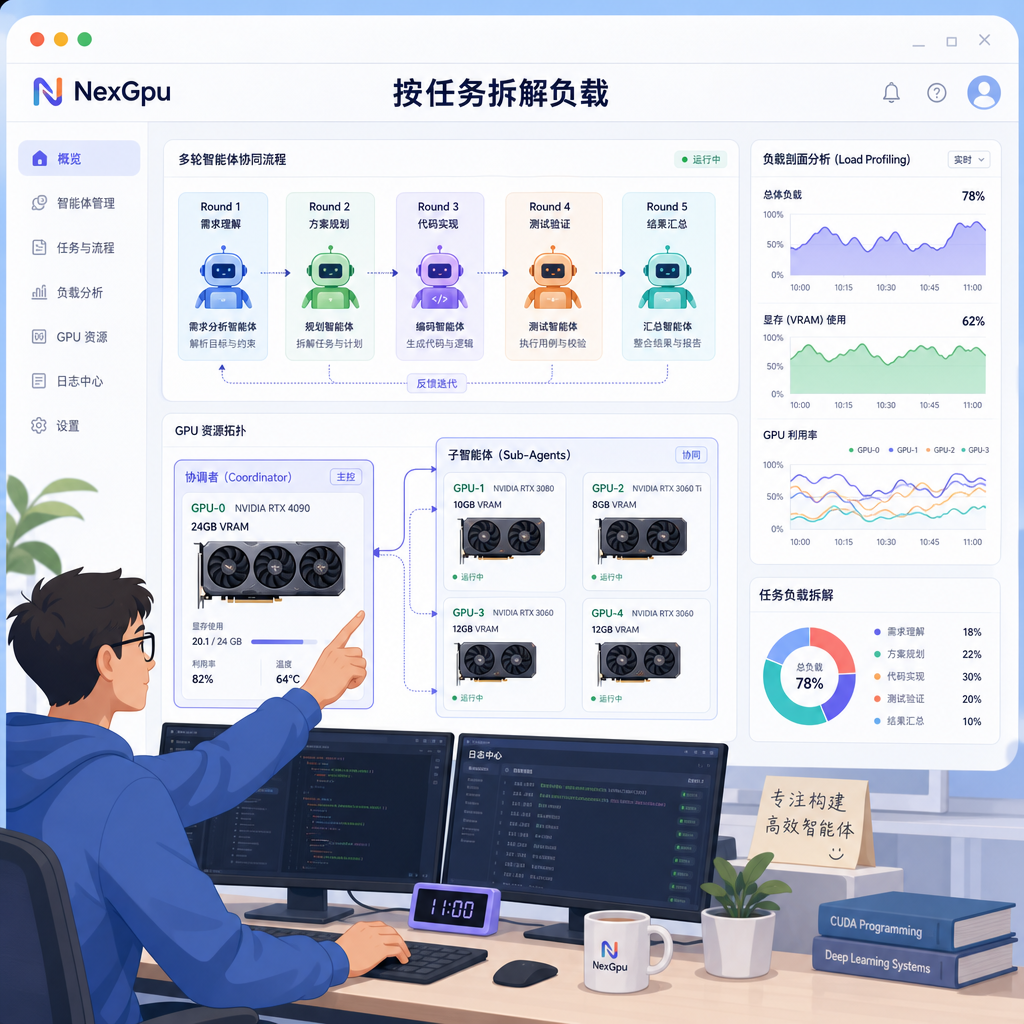
The core of agent workflows is multi-round loops. Planning might use a large model, subtasks use small models, and retrieval and verification switch again. A common mistake is running the entire chain on the same set of large GPUs and models, resulting in ever-thickening context, degraded accuracy, and wasted compute.
Start with load profiling. Track the average number of calls per task, input/output tokens per round, and peak concurrency. Then break it down: the main orchestrator agent uses high-memory GPUs for large context windows, while sub-agents use more cost-effective mid-range cards for tool calls or lighter inference. Context management is key—don't stuff the entire history back every time. Compression summaries, hierarchical tool calls, and on-demand retrieval can significantly cut redundant computation. Some teams have cut monthly bills by about 40% by routing simple subtasks to smaller models.
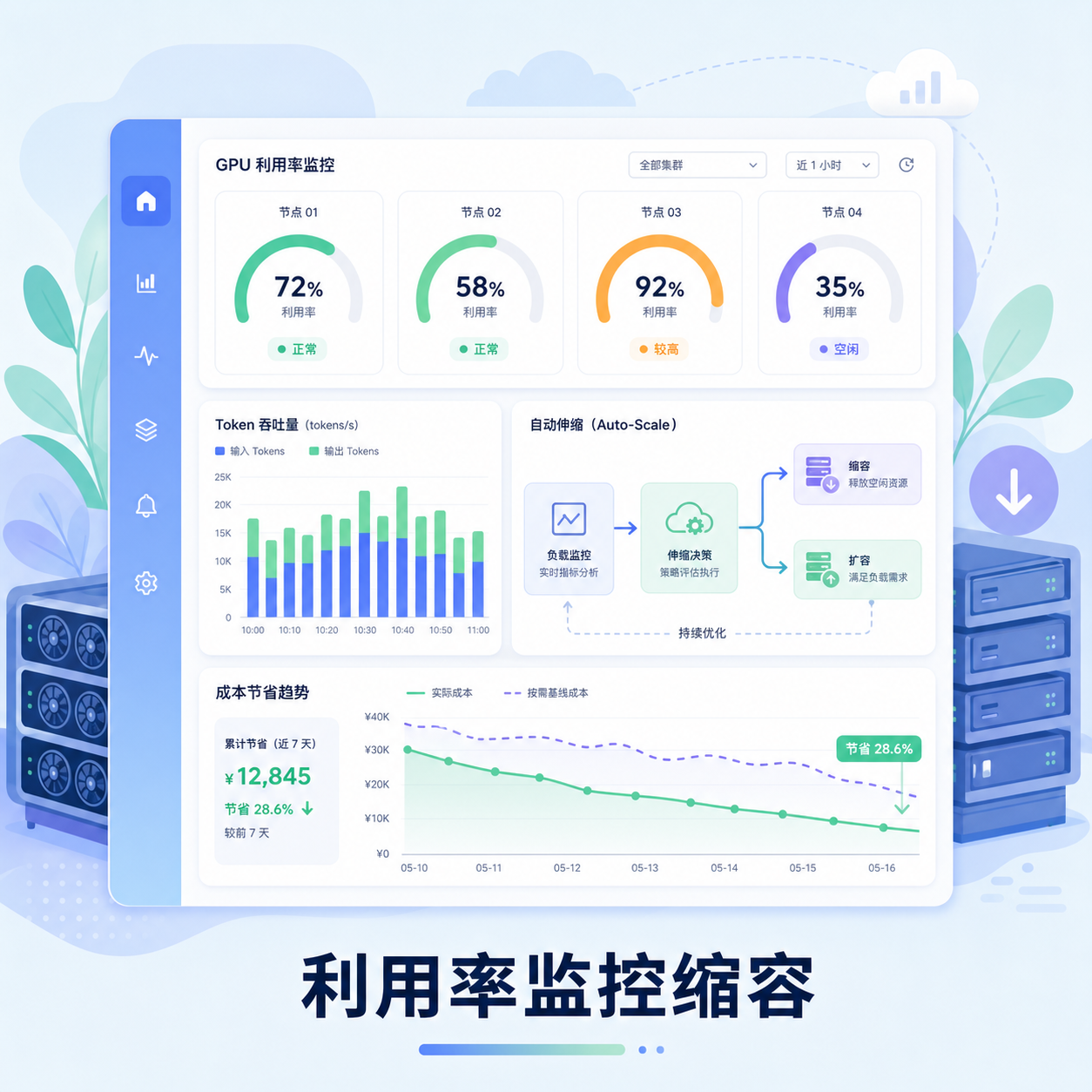
For deployment, use containers or serverless-style launches to spin up instances on demand. Scale down when agents are idle, and scale out when tasks surge. Don't forget to monitor retry rates: high data latency or frequent tool failures amplify call counts. A stable, low-latency data layer reduces this waste.
How to Implement Elastic Scheduling: From Single Node to Cluster Rhythm
The best fit for agents in the cloud is "on-demand + scalable." Start with a single card or small cluster to validate the flow, confirm token efficiency and success rates, then add more cards. Platforms that support second-level or minute-level startup can match sudden concurrency spikes—like customer service peaks or batch document processing.
For scheduling strategy, prioritize preemptible or spot resources for non-critical paths, and use on-demand for critical paths to ensure SLAs. Interconnect bandwidth between GPUs must be sufficient, otherwise data movement during multi-agent coordination becomes a bottleneck. Memory management also needs attention: KV caches can blow up easily; timely eviction or quantization improves throughput. In heterogeneous environments common in China, where Nvidia and domestic cards are mixed, a unified scheduling layer is crucial to avoid fragmented resource pools.
Common pitfalls: underestimating sustained load and provisioning only for peak, resulting in idle waste during valleys; or over-provisioning and causing queues during peaks, ruining user experience. The fix is to set auto-scaling rules triggered by queue length or token throughput. During testing, simulate real loop counts, not just single rounds.
Platforms like NexGpu, which offer cloud compute resources, are quite suitable here. They provide elastic GPU rental with fast startup and on-demand scaling, perfectly adapting to the fluctuating demands of agents. Teams don't have to worry about hardware procurement and maintenance, and can focus directly on workflow optimization.
A Few Hard-Hitting Cost Control Measures
- Context Discipline: Clean up irrelevant info before each call; use summaries instead of full history. Load tool definitions hierarchically, not dozens of schemas at once.
- Model Routing: Use small models for simple decisions, and only bring in large models for complex reasoning. Quantized or distilled versions are often sufficient for subtasks.
- Caching and Reuse: Prompt caching, retrieval result caching—reduce redundant inference.
- Failure Circuit Breakers: Set maximum loop counts and timeouts to avoid infinite retries that burn money.
- Utilization Monitoring: Track GPU occupancy and token output in real time; scale down when utilization is low.
If you solidify these, the same budget can run more concurrent agents. In the agent era, compute is no longer just "available"; it's about "stable, elastic, and cost-effective."
Case Study: From Chatbot to Workflow Automation
For example, an internal knowledge assistant upgraded to an agent: previously users asked and got answers; now it automatically searches databases, writes reports, sends emails, and checks results. Per-task calls went from 1 to about 15, with a massive token surge. The team switched to cloud elastic deployment, maintaining a baseline instance normally and auto-scaling during peaks. Combined with context compression and sub-agent splitting, monthly costs stayed controllable, and responses were more stable. Similar scenarios are increasingly common in customer service, developer assistants, and operations automation.
As the domestic inference share continues to rise and agent adoption accelerates, the flexibility of cloud GPU rental will become even more advantageous. Building your own cluster takes time and carries high risk; small and medium teams can go to market faster with mature platforms.
NexGpu supports such elastic scenarios with its general capabilities, making it convenient to iterate on agent workflows without being locked into hardware. In practice, run a small-scale trial for a few days to understand the real multipliers, then decide on a long-term strategy. Don't wait until the bill arrives to regret it.
Agents turn inference from an "event" into a "process," and cloud GPU rental must follow suit—from "temporary" to "schedulable, always-on resources." If you calculate the multipliers carefully and fine-tune scheduling, you can capitalize on this wave of demand rather than being dragged down by costs.


Comments(0)