 NexGPU-算力租赁,GPU服务器,GPU云算力,AI服务器租用-新闻博客
When your large model application moves from a local development environment to the real production stage, the most obvious challenge is that as request concurrency skyrockets, the once "handy" single-machine setup starts to struggle.
If you're still struggling with how to double model throughput and handle complex tensor parallelism, then migrating from experimental local frameworks to production-grade vLLM deployment is an advanced step every developer must take.
1. From Prototype to Production: Why vLLM is the Inevitable Choice
Many developers initially use Ollama for quick validation, but when business needs evolve into multi-user concurrent access and require a strict OpenAI-compatible interface, vLLM, with its efficient PagedAttention memory management, becomes the undisputed production首选. However, vLLM's high performance depends not only on algorithms but also on underlying hardware parallelism strategies.
In a previous article, we discussed Ollama's introductory deployment in detail, but for production environments, you need to consider not just "getting it running" but "computing fast" and "cost-effective."
2. Computing Power Selection: Precisely "Slice GPUs" Based on Throughput Goals
In production deployment, VRAM is the first threshold, and interconnect speed (e.g., PCIe/NVLink) is the second bottleneck. The GPU marketplace provided by NexGPU allows you to flexibly filter by GPU count, region, and price, which is especially critical for distributed inference:
- Small to medium-scale inference: RTX 4090 or 5090 clusters are recommended for their high cost-effectiveness, suitable for lightweight model services under high concurrency.
- Ultra-large-scale models (MoE/235B+): Rent A100/H200 via multi-GPU node filtering and use multi-GPU parallelism (TP/PP) to distribute computational load.
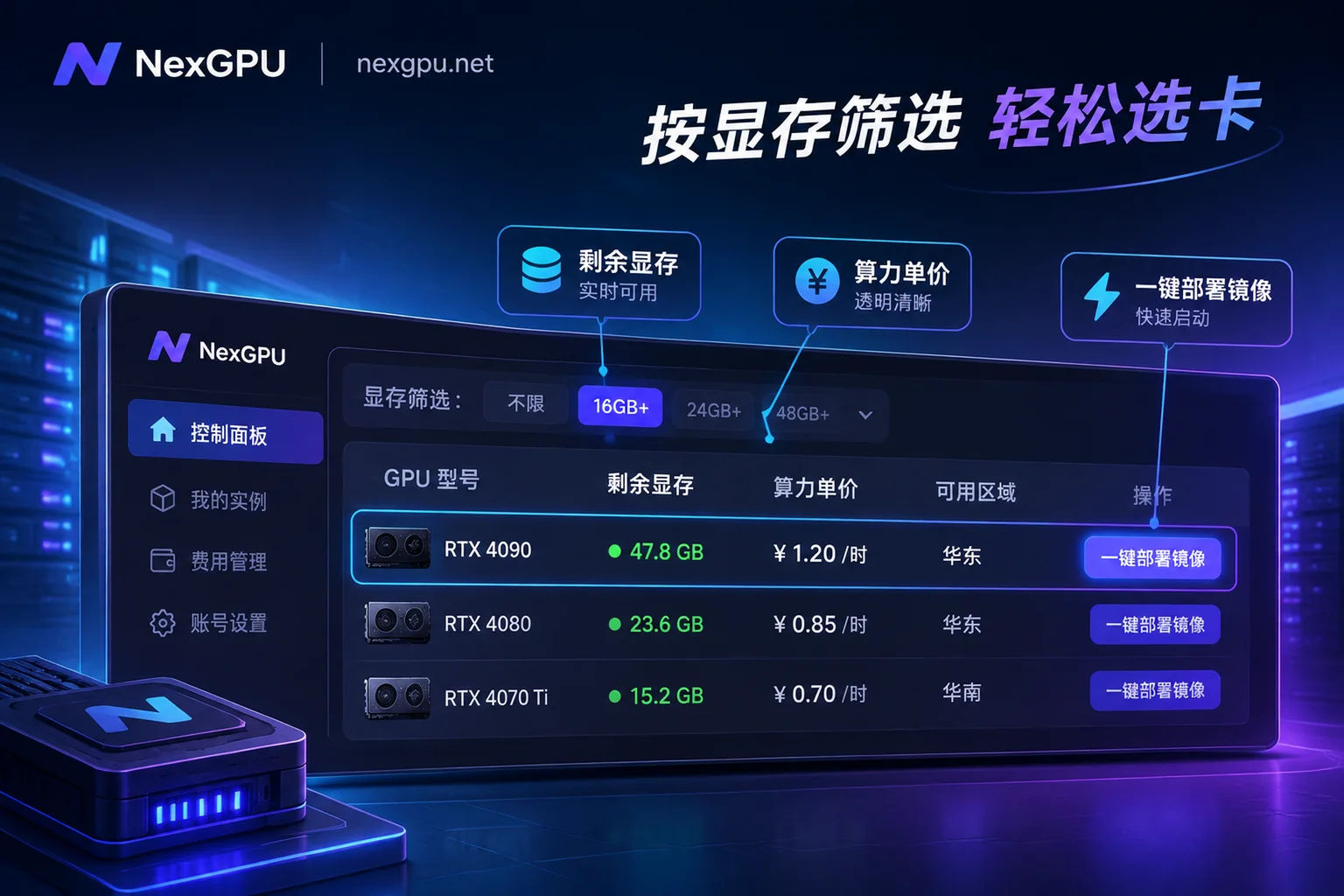
3. One-Click Deployment: NexGPU Image Accelerates the Launch Process
Instead of wasting time installing CUDA drivers and configuring various versions of vLLM dependency environments, why not use our pre-built image templates? These templates come with drivers and common inference frameworks pre-installed, and once launched, they provide an OpenAI-compatible interface that directly connects to your backend services.
If you have specific CUDA environment requirements, you can also deploy via custom Docker images. This "ready-to-use" model compresses deployment time from "hours" to "minutes."
4. Calculating ROI: Why Pay-Per-Second Billing is a Lifesaver for Production
Many developers overlook "hidden costs" when choosing a solution. In NexGPU's billing system, computing fees are charged per second, and after an instance is stopped, only storage costs are retained. This means you can automatically scale computing power based on business traffic peaks and valleys—open multiple clusters during peak times, and stop them with a single click during low periods while keeping the disk, turning "cloud costs" into "efficiency costs."
Advanced reference: If you encounter bottlenecks in multi-GPU inference utilization, please refer to our previous multi-GPU utilization troubleshooting guide to systematically optimize your inference throughput from parallel settings to load investigation.
Take Action Now
No real-name authentication required; register and start building your production environment immediately. Go to the NexGPU marketplace now, choose the GPU that best fits your model, and embark on your high-performance vLLM inference journey.



