 NexGPU-算力租赁,GPU服务器,GPU云算力,AI服务器租用-新闻博客
If your workload is dominated by long context or high-concurrency decoding, H200 is the better value. For short context, low concurrency, or prefill-heavy tasks, sticking with H100 saves money. This assessment rests on the fact that both use identical compute cores, so the H200 premium only buys greater memory capacity and bandwidth.
What the Price Difference Buys: Memory—H100 and H200 Share the Same Compute Core
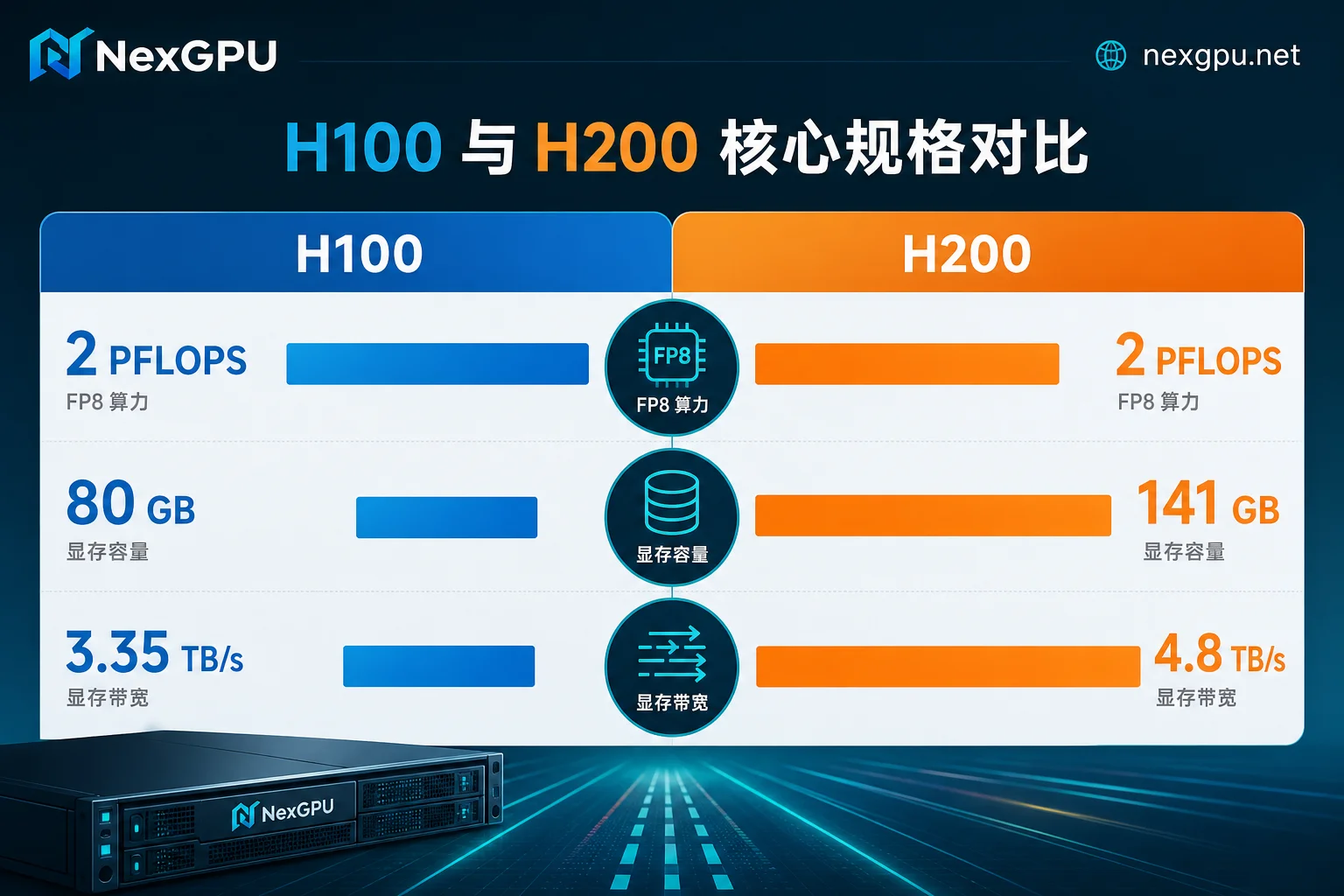
Many engineers mistakenly assume the H200 packs stronger compute. In reality, the NVIDIA H200 SXM and H100 SXM share the same Hopper GH100 architecture, with identical FP8 dense peaks of 2 PFLOPS and identical 900 GB/s NVLink 4.0 interconnect bandwidth. The true upgrade lies in the memory subsystem: the H200 features 141GB of HBM3e memory at 4.8 TB/s, compared to the H100's 80GB HBM3 at 3.35 TB/s—a 76% increase in capacity and a 43% boost in bandwidth.
This means the extra money for an H200 buys not more floating-point throughput, but faster data movement and more storage. For workloads that don't rely on high bandwidth or large memory, this hardware enhancement translates into no real performance gain, so the premium fails to improve cost per unit of output.
Decode Throughput Differences: When Does Bandwidth Become the Bottleneck?
In LLM inference, the autoregressive decoding phase is a typical memory-intensive task. For every token generated, model weights and KV cache must be read from memory into the compute cores, which often sit idle waiting for data. Thus, memory bandwidth becomes the throughput bottleneck.
Public benchmark data shows that for large models like Llama 3 70B, the H200's output throughput is about 45% higher than the H100—rising from roughly 21,806 tok/s to 31,712 tok/s. This gap widens even further in long-context scenarios: when context exceeds 16K tokens, the KV cache grows dramatically, and the H200's higher bandwidth enables decode throughput 1.83 to 2.14 times that of the H100.
| Test scenario | Model size/Context | H100 baseline performance | H200 relative improvement | Key bottleneck |
|---|---|---|---|---|
| Standard inference | 70B-class output throughput | 21,806 tok/s | +45% (31,712 tok/s) | Memory bandwidth |
| Long context | 70B / >16K tokens | 1.0x (baseline) | 1.83~2.14x | KV cache read/write speed |
| Prefill phase | Any size | Same compute | Same compute, limited bandwidth gain | Compute core utilization |
Note that the above improvements apply only during the bandwidth-limited decode phase. For prefill-heavy workloads, since both have identical compute power, the H200 offers no clear advantage. These figures reflect real-world measurements from major GPU cloud platforms and MLPerf records, applicable to 70B-class models at specific context lengths.
Single-Card 70B: How Much Concurrency Can You Run?
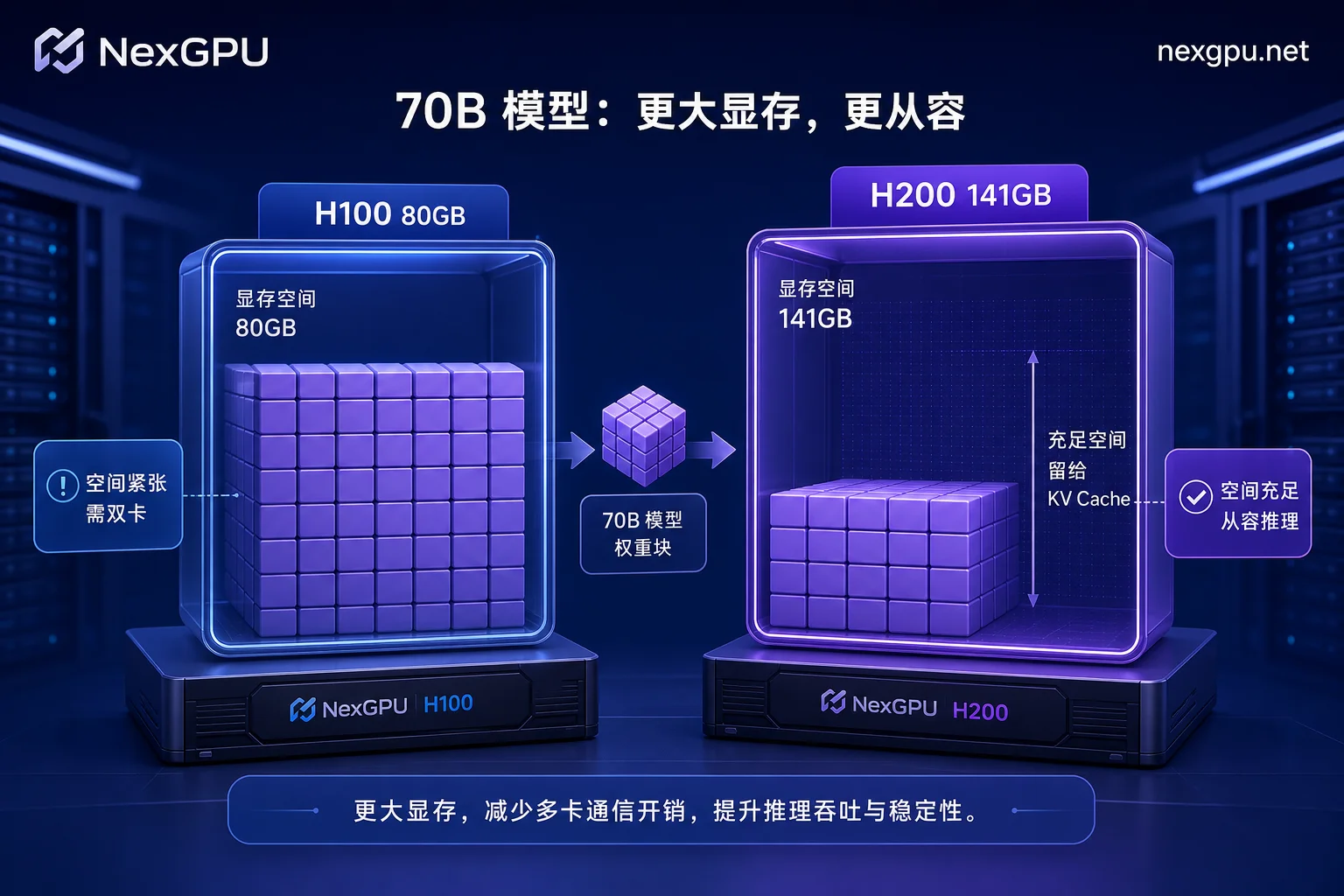
Memory capacity directly determines deployment complexity. For a 70B-parameter model, estimating "parameters × bytes per parameter" yields roughly 70GB for FP8 weights alone. Adding runtime overhead and a basic KV cache often pushes total memory demand near the 80GB limit. On an H100, this leaves almost no headroom, making out-of-memory (OOM) errors likely and forcing teams to use two-card tensor parallelism (TP), which adds inter-card communication latency.
In contrast, the H200's 141GB provides ample buffer, comfortably accommodating 70B FP8 weights plus a sizable KV cache, enabling single-card deployment. This not only saves the rental cost of an additional card but also eliminates TP communication overhead and scheduling complexity. To verify suitability for your specific workload, you can use the estimation methods in The Impact of FP8 and INT4 Quantization on GPU Memory, or simply run controlled tests on NexGPU's pay-as-you-go instances, substituting theoretical estimates with measured peak memory usage.
Is the Hourly Premium Worth It? Cost Per Million Tokens
The ultimate criterion for choosing between H100 and H200 is unit production cost. According to third-party cloud platform data (sampled around 2024–2025), the hourly rental for H100 SXM ranges from $2.59 to $3.29, while H200 SXM ranges from $3.59 to $4.59—a premium of 25% to 40%. Premiums vary by platform and region.
We can convert this premium into a per-million-token cost formula:
$$ \text{Cost ratio} = \frac{1+\text{premium rate}}{1+\text{throughput increase}} $$
The break-even point occurs when the throughput increase equals the premium rate. For example, if an H200 costs 25% more per hour but delivers a 45% throughput boost, the cost per million tokens drops by about 13.8%. If the premium is 40% but the throughput gain is 45%, the cost reduction is only about 3.5%. However, if the workload's throughput improvement is less than 25%, or if low concurrency leads to underutilized GPUs, paying the high premium will raise unit costs. Therefore, decisions must be based on average throughput under real traffic, not peak figures.
Three Workloads Where Sticking with H100 Saves More
Not every scenario benefits from migrating to the H200. In the following three cases, the H100 remains the more cost-effective choice:
- Short context, short output: These workloads have low decode ratios and small KV cache, so bandwidth bottlenecks are minimal, and the H200's high bandwidth cannot be exploited.
- Low concurrency or prefill-heavy tasks: The bottleneck is compute, not memory movement. Since both have identical compute power, the H100 offers the same performance at a lower price. If you need to cut costs further, consider renting an A100 as a lower-tier alternative.
- Already stable multi-card setups: If your existing cluster has successfully addressed memory issues through optimization, the costs of re-tuning, environment migration, and potential compatibility risks from switching cards may offset any token cost savings.
Additionally, be wary of the misconception that adding cards yields linear speedup. In multi-card environments, redundant KV cache replication and communication overhead lead to diminishing returns; the H200's advantage does not scale indefinitely with more cards. This conclusion stems from public observations in large-scale cluster deployments, not from speculation in this article.
Extra Variable for 671B-Class Models: What You Save When 8×80GB Isn't Enough
When model size exceeds the physical limits of a single node, the decision logic shifts from "cost-performance" to "feasibility." The DeepSeek-V3/R1 671B model requires about 1.4TB of memory in FP16 precision. Even with native FP8 and MTP parameters, it needs roughly 685GB—exceeding the 640GB physical limit of a standard 8×80GB H100 node.
In this case, the H200's value lies in avoiding complex engineering compromises:
- Option A (H100): You must use AWQ 4-bit quantization to compress weights to about 335GB to run on a single node, sacrificing some precision; or deploy across 16×80GB nodes, incurring significant network communication overhead.
- Option B (H200): A single 8×H200 node provides roughly 1128GB of memory, directly accommodating the unquantized FP8 model, eliminating precision trade-offs and inter-node communication burdens.
For such massive models, as shown in DeepSeek-R1 Private Deployment GPU Configuration, choosing the H200 effectively buys "no quantization" and "no multi-node" engineering certainty—a hidden cost saving often underestimated.
Frequently Asked Questions
Is the H200 truly more powerful than the H100?
No. Both use the identical GH100 compute core with the same FP8 dense peak of 2 PFLOPS. The H200's advantage lies solely in its 141GB HBM3e memory and 4.8 TB/s bandwidth, not in raw compute ability.
Can the 70B model run FP8 on a single H200?
Yes. 70B FP8 weights take about 70GB; adding KV cache and runtime overhead, total usage typically stays under 100GB. The H200's 141GB can handle it easily, unlike the H100, which often lacks headroom and forces dual-card parallelism.
Why is H200 recommended for long-context inference?
Long context leads to massive KV caches, and the decode phase frequently reads and writes memory. The H200's bandwidth is 43% higher than the H100's, yielding 1.83–2.14x throughput in 16K+ context scenarios, significantly lowering cost per token.
When is the H100 a better choice?
When the workload is prefill-dominated, context is extremely short, or concurrency is very low. In such cases, bandwidth isn't the bottleneck, and since the H100 rents for 25–40% less, choosing it directly saves money if throughput gains are under 25%.
How do I accurately assess whether an upgrade is worthwhile?
Don't just look at spec sheets. Rent an instance on a platform like NexGPU, run a side-by-side test with real business data, record actual throughput and peak memory, then stop it and apply the per-million-token cost formula to make your final decision.


Comments(0)